

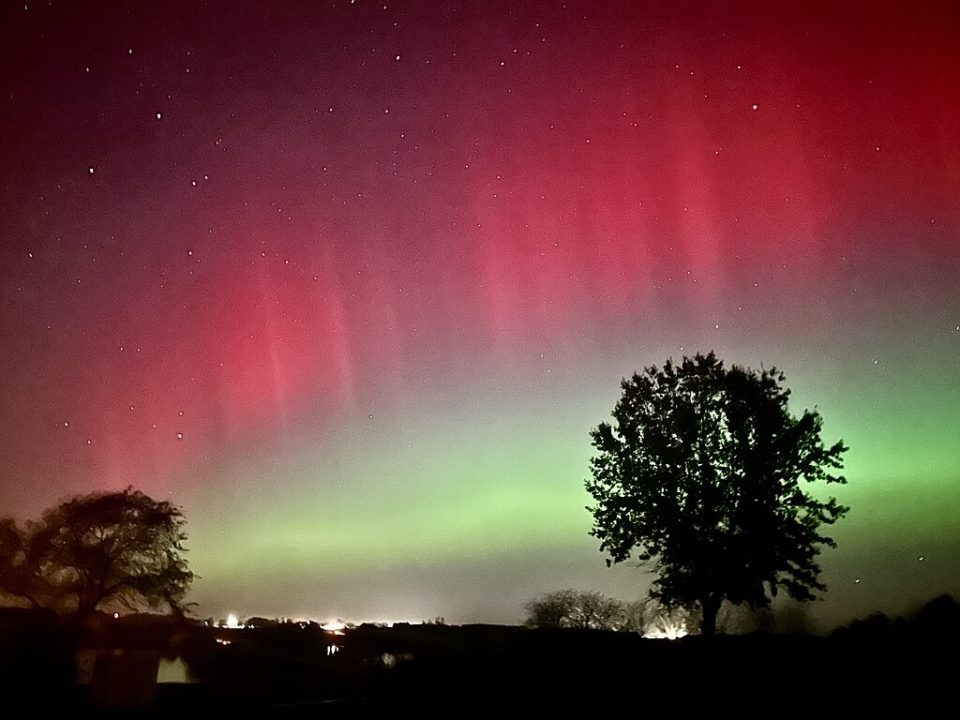
NORTH ARKANSAS — If you’ve ever seen ribbons of green, purple, or pink dancing across a starry sky, you’ve witnessed the northern lights, one of nature’s most stunning displays. Known scientifically as the aurora borealis (in the Northern Hemisphere) or aurora australis (in the Southern Hemisphere), these glowing curtains of light are caused by solar energy colliding with Earth’s atmosphere.
Here’s a clear, simple breakdown of what they are — and why they matter.
How the Northern Lights Form
- Solar Storms Launch Particles The sun constantly releases charged particles (mostly electrons and protons) in a stream called the solar wind. During solar flares or coronal mass ejections (CMEs), massive bursts of these particles shoot toward Earth.
- Earth’s Magnetic Field Acts as a Shield Our planet’s magnetic field funnels these particles toward the polar regions, where the field lines dip closest to the surface.
- Collision with Air Molecules When the particles hit oxygen and nitrogen in the upper atmosphere (60–250 miles up), they excite the molecules. As the molecules calm down, they release energy in the form of light — creating the aurora.
Why the Colors?
- Green: Most common — caused by excited oxygen at lower altitudes (~60 miles up).
- Red: Rare, higher-altitude oxygen (~200 miles).
- Purple / Pink / Blue: Nitrogen molecules, especially at the edges or lower parts of the display.
Where and When to See Them
- Best Locations: Within the auroral oval — a ring around the magnetic poles. → Alaska, Canada, Iceland, Norway, Finland, Sweden → Occasionally visible in northern U.S. states like Minnesota, Michigan, Montana — and rarely, Arkansas during strong storms.
- Best Time:
- Dark, clear nights (September–April)
- Peak solar activity (we’re in Solar Cycle 25, peaking 2024–2026)
- After midnight local time
Can You See Them in Arkansas?
Rarely — but yes, during major solar storms. The last strong display reached Arkansas in May 2024, when a G5 geomagnetic storm painted faint red and green glows visible to the naked eye in rural areas like Stone County and Cleburne County.
“It looked like a faint neon cloud with a pink edge,” said one Batesville resident. “Never thought I’d see the northern lights from my backyard.”
How to Catch the Next Show
- Check Space Weather → NOAA Space Weather Prediction Center → Look for Kp index 6+ or G3–G5 storms
- Use Apps → Aurora Alerts, My Aurora Forecast, Space Weather Live
- Find Dark Skies → Head to rural spots: Buffalo River, Mount Magazine, Petit Jean State Park
- Bring a Camera → Long-exposure photos (10–30 seconds) reveal colors the eye can’t always see.
Fun Fact
The word “aurora” comes from the Roman goddess of dawn, and “borealis” means “northern” — a name coined in 1621 by astronomer Pierre Gassendi.
Bottom Line: The northern lights are Earth’s way of turning solar energy into art. While Arkansas isn’t prime viewing territory, strong solar storms can bring the show south — and with the sun nearing peak activity, now’s the time to keep an eye on the sky.
Stay updated: Follow NOAA Aurora Dashboard
