

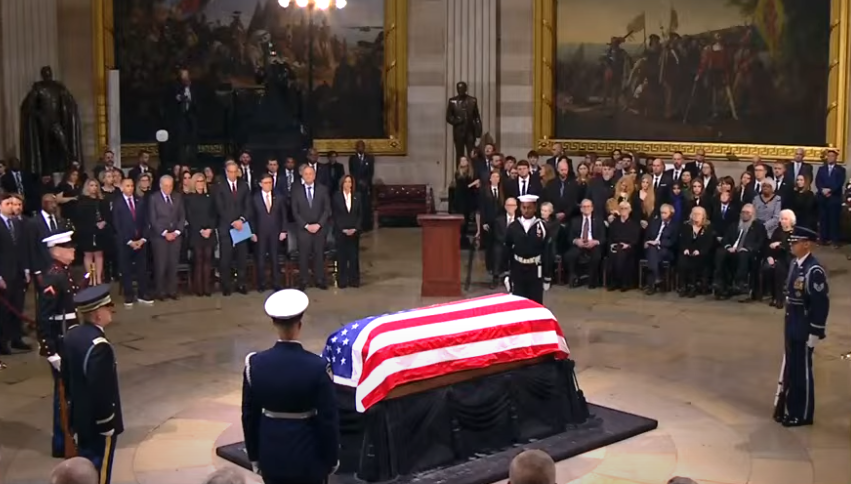
WASHINGTON — Nearly 44 years after leaving the White House in a humbling defeat, the 39th president of the United States, Jimmy Carter, has returned to the nation’s capital for three days of state funeral rites, starting Tuesday.
Carter’s casket, which had been lying in repose at the Carter Presidential Center in Atlanta since Saturday, departed Georgia Tuesday morning, accompanied by members of his family. The late president’s remains were flown via Special Air Mission 39 to Joint Base Andrews in Maryland aboard a Boeing 747 variant—commonly recognized as Air Force One when used by a sitting president. Carter, however, never traveled aboard the jet during his presidency, as it came into service under George H.W. Bush in 1990.
Upon arrival in Washington, the casket was escorted by motorcade to the U.S. Capitol, where lawmakers and dignitaries gathered to pay their respects.
Tributes in Georgia and Washington
The solemn procession began in Georgia, where military pallbearers carried the casket from the Carter Presidential Center to an awaiting aircraft. As cannons fired nearby, hymns such as “Amazing Grace” and “Blessed Assurance” played—a fitting tribute to Carter’s deeply rooted Baptist faith.
The ceremony continued upon arrival in Washington, with cannons firing and a military band playing as the casket was removed from the plane. A hearse bearing the presidential seal carried Carter’s remains to the U.S. Capitol Rotunda. Along the way, the procession paused at the U.S. Navy Memorial, a nod to Carter’s service as the only U.S. Naval Academy graduate to become commander in chief.
Inside the Capitol, the casket rested on the historic Lincoln catafalque, a platform built in 1865 to hold the remains of Abraham Lincoln. Vice President Kamala Harris, Senate Majority Leader John Thune, and House Speaker Mike Johnson delivered eulogies highlighting Carter’s legacy of faith, service, and humility.
“Jimmy Carter was that all-too-rare example of a gifted man who walked with humility, modesty, and grace,” Harris remarked, recalling his ability to connect with Americans during his 1976 campaign.
The ceremony also included a performance of “My Country, ‘Tis of Thee” by the U.S. Naval Academy Glee Club, followed by congressional leaders and Harris placing wreaths beside the casket. Members of Carter’s family, including his grandchildren, were seen wiping away tears during the tribute.
Remembering a Humble Leader
Jimmy Carter passed away on December 29 at the age of 100, leaving behind a legacy marked by his unwavering commitment to public service. While his presidency from 1977 to 1981 was often criticized for its challenges, Carter found renewed admiration in his post-presidency work, particularly his efforts with Habitat for Humanity.
Despite the pageantry of the state funeral, the ceremonies carried an air of irony. Known for his disdain for pomp and circumstance, Carter eschewed many ceremonial trappings during his time in office. He famously requested the Marine Band refrain from playing “Hail to the Chief” and once delivered a televised address from the White House wearing a cardigan sweater to emphasize energy conservation.
Yet, as his casket traveled through the streets of Washington and was placed on display in the Rotunda, the nation honored a man who, despite his modesty, represented the highest ideals of American leadership.
A Legacy Beyond Washington
Carter’s funeral rites will continue Wednesday as his body lies in state, with a state funeral planned for Thursday at the Washington National Cathedral. President Joe Biden is expected to deliver a eulogy during the service.
As Carter’s remains left Georgia for the final time, his legacy was brought into focus—not just as a politician but as a compassionate leader. From his roots in Plains, Georgia, to the world stage, Carter’s unwavering commitment to service, faith, and humanity continues to inspire generations.
