

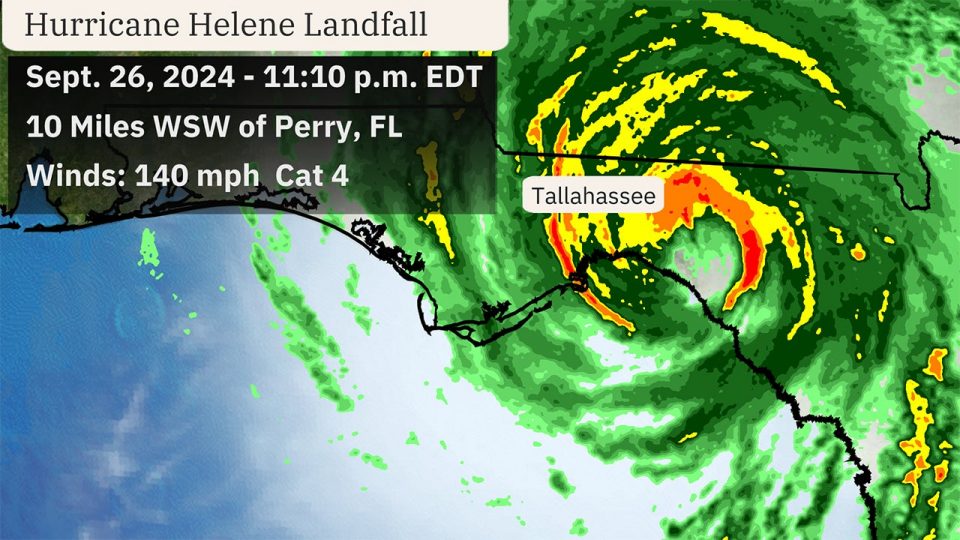
Hurricane Helene made a powerful landfall late Thursday night in northwestern Florida as a Category 4 storm, with forecasters warning of a “nightmare” storm surge and widespread impacts across the southeastern United States. The storm made landfall at 11:10 p.m. EDT near the mouth of the Aucilla River in Florida’s Big Bend area, packing winds of up to 140 mph. This area, already vulnerable after last year’s Hurricane Idalia, faced similar destruction as Helene bore down with ferocious intensity.
The National Hurricane Center reported that hurricane and flash flood warnings extended well beyond Florida, reaching northern Georgia and western North Carolina. Early damage assessments revealed more than a million homes and businesses without power across Florida, with an additional 50,000 in Georgia also affected. In response to the catastrophic storm, governors in Florida, Georgia, Alabama, the Carolinas, and Virginia declared states of emergency.
Tragically, Helene claimed lives even before the storm’s full effects were realized. In Florida, one person died after a sign fell on their car, while two others were killed in Georgia due to a possible tornado.
At a late-night press conference, Florida Governor Ron DeSantis expressed concerns over the storm’s toll. “When Floridians wake up tomorrow morning, we’re going to be waking up to a state where very likely there’s been additional loss of life and certainly there’s going to be loss of property,” he said somberly.
In the Big Bend area, the National Weather Service issued an “extreme wind warning,” urging residents to take immediate shelter. “Treat this warning like a tornado warning,” the agency posted on social media platform X, emphasizing the danger posed by the approaching eyewall.
Even before Helene’s landfall, its power was felt across the region. Tropical storm-force winds and hurricane-strength gusts battered Florida’s west coast, with water inundating roads and intersections in places like Siesta Key and St. Pete Beach. Debris from a previous fire in Cedar Key, just days before, was swept ashore by rising tides.
Further inland, North Carolina experienced heavy rainfall, with up to 14 inches of rain forecasted in some areas, leading to flash flood warnings. In Georgia, hurricane-force winds of over 110 mph were anticipated to hit several counties.
Tragic reports from south Georgia detailed the deaths of two individuals when a possible tornado struck a mobile home in Wheeler County. The National Weather Service had issued a series of tornado warnings, with 12 in total spanning Thursday afternoon and evening.
The sparsely populated Big Bend region, known for its fishing villages and vacation spots, bore the brunt of Helene’s fury. Many residents had chosen to stay despite evacuation orders. Authorities in Taylor County, in a chilling advisory, urged those remaining to write identifying information on their arms in permanent marker—a grim reminder of the storm’s deadly potential.
While some residents, like local fisherman Philip Tooke, chose to ride out the storm aboard their boats, the destruction from Hurricane Helene is expected to be widespread. Comparisons to past storms, such as 2018’s Category 5 Hurricane Michael, loom large, as Florida and surrounding states brace for more devastation and the long road to recovery.
