

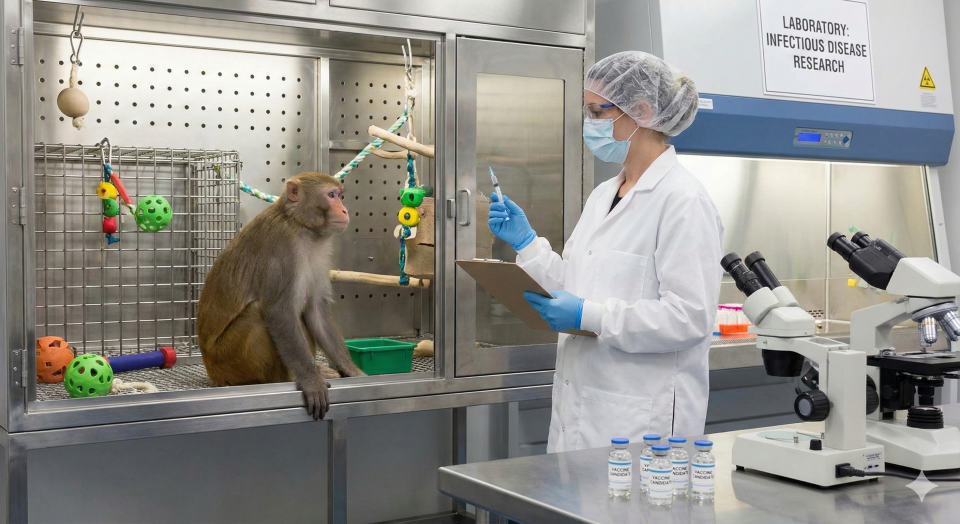
ATLANTA, Ga. — In a landmark decision, the Centers for Disease Control and Prevention (CDC) has officially announced it will cease all experiments involving monkeys in its research laboratories, marking a significant pivot for the agency that has long utilized primate testing for studies on infectious diseases, vaccines, and medical treatments.
The move, revealed on November 21, 2025, involves phasing out ongoing primate research by the end of the year, with a transition to innovative, non-animal alternatives already in progress. These include cutting-edge computer modeling, organ-on-a-chip technologies, and advanced cell culture systems designed to more accurately mimic human biology.
“This is a historic victory for animal welfare and scientific progress,” said a spokesperson for the Physicians Committee for Responsible Medicine (PCRM), one of many animal rights groups hailing the announcement. For decades, organizations like PETA and PCRM have campaigned against the use of monkeys in labs, highlighting ethical issues such as animal suffering and scientific drawbacks like species differences that can limit applicability to humans.
CDC officials emphasized that the change will not hinder public health advancements. “We’re embracing safer, more humane, and more precise methods that will drive innovation forward,” an agency statement noted. Researchers suggest this could establish a new standard globally for disease study and treatment development, potentially influencing other institutions like the National Institutes of Health.
The decision affects nearly 200 macaques currently housed at CDC facilities, with their fate—transfer to sanctuaries or possible euthanasia—still under discussion. Advocacy groups are pushing for humane relocation options.
The phase-out aligns with broader trends in biomedical research, where ethical pressures and technological advances are reducing reliance on animal models. The CDC’s action follows years of scrutiny and comes amid reports of similar shifts in other federal agencies.
For more details, visit the CDC’s website or contact animal welfare organizations for advocacy resources. This development underscores a growing consensus that science can thrive without animal testing.
