

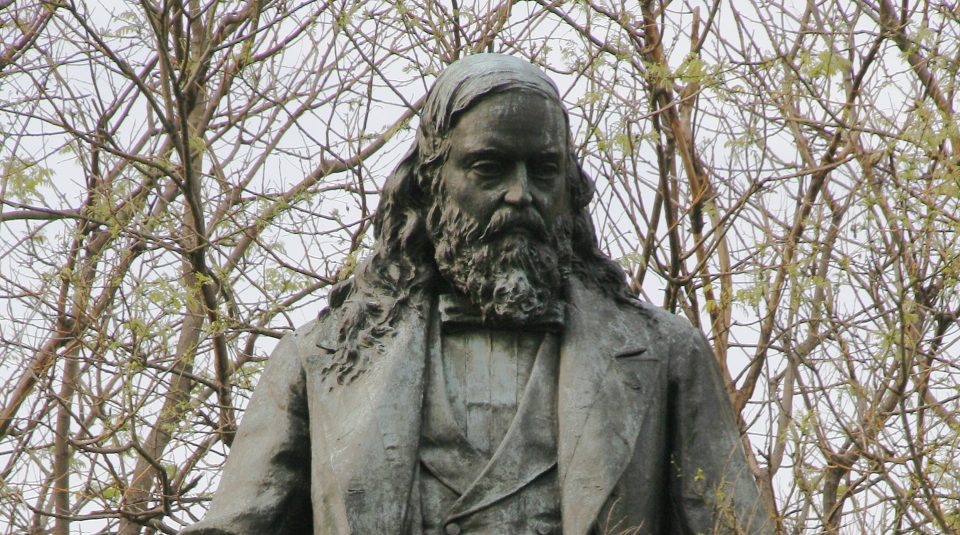
Washington, D.C – The National Park Service has announced plans to restore and reinstall the statue of Albert Pike, a prominent figure with deep historical roots in Arkansas, to its original location in Washington’s Judiciary Square. This move, set for October, aligns with recent executive orders under President Donald Trump aimed at preserving historical monuments and countering efforts to reinterpret America’s past.
The statue, depicting Pike in civilian attire as a revered Freemason leader, was toppled by protesters on Juneteenth 2020 amid nationwide demonstrations following George Floyd’s death. As the only outdoor statue of a Confederate military leader in the nation’s capital, it has long been controversial. Pike, who served briefly as a Confederate brigadier general, is better known for his decades as Sovereign Grand Commander of the Scottish Rite of Freemasonry. The restoration follows a similar decision by Defense Secretary Pete Hegseth to return the “Reconciliation Monument” to Arlington National Cemetery, emphasizing the administration’s stance against “erasing American history.”
Pike’s ties to Arkansas run deep, making this national development particularly resonant for the state. Born in Boston in 1809, Pike arrived in Arkansas Territory in 1832, initially reaching Fort Smith before settling in Little Rock in 1833. He quickly integrated into Arkansas society, teaching school and writing for the Arkansas Advocate under the pseudonym “Casca.” By 1834, he owned the newspaper, using it to promote Whig Party ideals. Admitted to the bar in 1837, Pike became a renowned lawyer, representing Native American tribes like the Creek, Choctaw, and Chickasaw in claims against the federal government. He authored The Arkansas Form Book, a legal guide, and was the first reporter for the Arkansas Supreme Court.

Politically active, Pike joined the Know Nothing Party in 1854 and helped introduce it to Arkansas. In 1858, he signed a circular advocating the expulsion of free Blacks from the state as part of a Little Rock committee. During the Civil War, despite initial resistance to secession, Pike commanded Confederate forces in the Indian Territory and later served as an associate justice on the exiled Arkansas Supreme Court in Washington, Arkansas, from 1864 to 1865.
Beyond law and politics, Pike contributed to Arkansas’s development by campaigning for a transcontinental railroad, securing a charter in 1853. His literary works, including poetry collections like Prose Sketches and Poems Written in the Western Country (1834), reflected his Western experiences. After the war, he left Arkansas but remained influential through his Masonic leadership until his death in 1891.
Arkansas honors Pike’s legacy through several landmarks. The Albert Pike Memorial Temple in Little Rock, listed on the National Register of Historic Places, serves as the headquarters for the Arkansas Grand Lodge of Freemasons and houses York Rite bodies. The Albert Pike Highway, a historic auto trail spanning over 900 miles from Hot Springs through Fort Smith to Colorado Springs, crosses the Ozark Mountains. Additionally, the Albert Pike Recreation Area in the Ouachita National Forest offers camping and trails, named in his honor.
While the D.C. statue’s restoration has drawn criticism, including from Congresswoman Eleanor Holmes Norton, who plans legislation to relocate it to a museum, it underscores Pike’s multifaceted role in American history. In Arkansas, where his contributions to law, journalism, and Freemasonry are celebrated, the development serves as a reminder of the state’s complex historical figures.
For more on Arkansas history, visit the Arkansas Department of Parks, Heritage, and Tourism website.
