

Little Rock, Arkansas– A federal judge’s temporary injunction has halted the enforcement of Arkansas’s Act 573 of 2025, which mandates the display of the Ten Commandments in public school classrooms, in four northwest Arkansas school districts—Fayetteville, Springdale, Bentonville, and Siloam Springs. The ruling, issued by U.S. District Judge Timothy L. Brooks on August 4, 2025, cites longstanding Supreme Court precedent declaring such displays unconstitutional, sparking a heated debate over religious freedom and historical tradition in Arkansas, including in Batesville and Independence County.
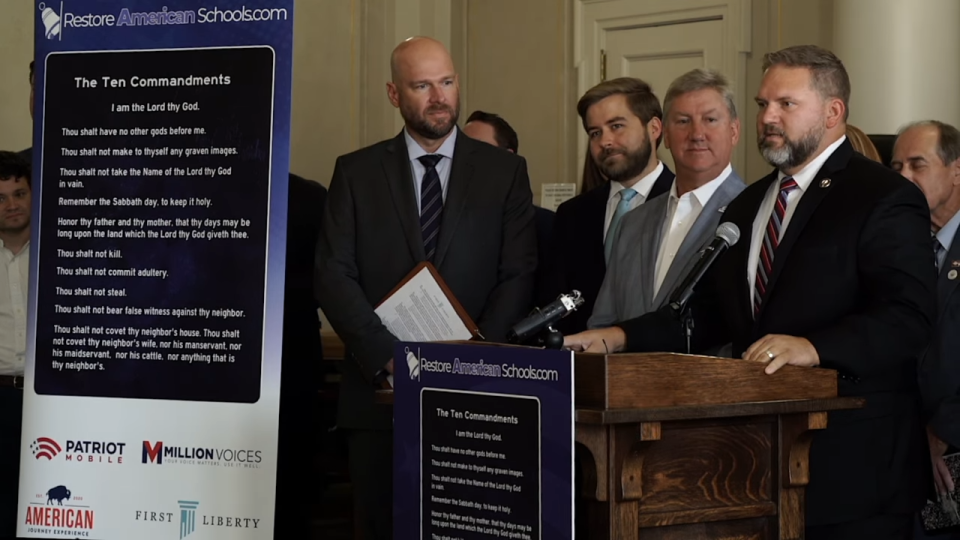
Act 573, signed by Governor Sarah Huckabee Sanders in April 2025, requires all public schools to prominently display a durable poster or framed copy of the Ten Commandments, specifically the King James Version, in every classroom and library by August 5, 2025. The law, sponsored by Sen. Jim Dotson (R-Bentonville) and Rep. Alyssa Brown (R-Heber Springs), allows posters to be funded through private donations. While the injunction applies only to the named districts, schools elsewhere, such as Pine Bluff, have displayed donated posters, with 288 Arkansas schools “adopted” by donors via RestoreAmericanSchools, according to The Pine Bluff Commercial.
The lawsuit, filed by the American Civil Liberties Union (ACLU), Americans United for Separation of Church and State, the Freedom From Religion Foundation, and Simpson Thacher & Bartlett LLP on behalf of seven multifaith and nonreligious families, argues that Act 573 violates the First Amendment’s Establishment and Free Exercise Clauses. Judge Brooks, in a 62-page opinion, referenced the 1980 Supreme Court case Stone v. Graham, which struck down a nearly identical Kentucky law for lacking a secular purpose and promoting religious coercion. Brooks criticized the state’s arguments as “disingenuous” and “intellectually dishonest,” suggesting Arkansas is part of a coordinated multi-state effort to “inject Christian religious doctrine into public-school classrooms,” citing similar laws in Louisiana and Texas.
At a press conference on August 12, 2025, in the state Capitol’s Old Supreme Court room, Dotson and Brown defended Act 573, asserting its constitutionality based on historical tradition. “You cannot separate the history of our nation and the founding of our laws and justice system from the Ten Commandments,” Brown said, expressing confidence in a higher court upholding the law. David Barton of WallBuilders and Jeremy Dys of First Liberty Institute cited a 2019 Supreme Court ruling (American Legion v. American Humanist Association), arguing it shifted the burden to opponents to prove religious displays lack historical grounding. Dys called Brooks’ ruling “exactly backwards” from this precedent, while Barton noted the Ten Commandments’ historical significance in shaping U.S. law.
The ACLU and plaintiffs, including Jewish, Unitarian Universalist, and nonreligious families, argue the law’s mandated Protestant version of the Ten Commandments excludes other faiths and coerces students, particularly minors, into religious observance. Plaintiff Samantha Stinson, a Jewish parent, said, “Act 573 conflicts with our family’s beliefs that religious instruction belongs at home, not from government officials.”
In Batesville, approximately 100 miles east of the affected districts, Independence County school officials are monitoring the case, as Act 573 remains in effect locally. Community reactions are mixed, with some residents supporting the law’s emphasis on moral values and others concerned about its impact on diverse student populations. The 74 reported that Act 573 mirrors model legislation promoted by Barton, with 28 similar bills nationwide sharing near-identical language, suggesting a coordinated push.
Governor Sanders, in an X post, defended the law, stating, “The Ten Commandments are foundational to Western law and morality, and they should be displayed in public places.” She vowed to appeal Brooks’ ruling. Attorney General Tim Griffin, whose office is defending the law, said he is reviewing legal options. The case, Stinson v. Fayetteville School District No. 1, is ongoing, with potential for further hearings or a Supreme Court challenge to clarify precedents on religious displays in schools.
