

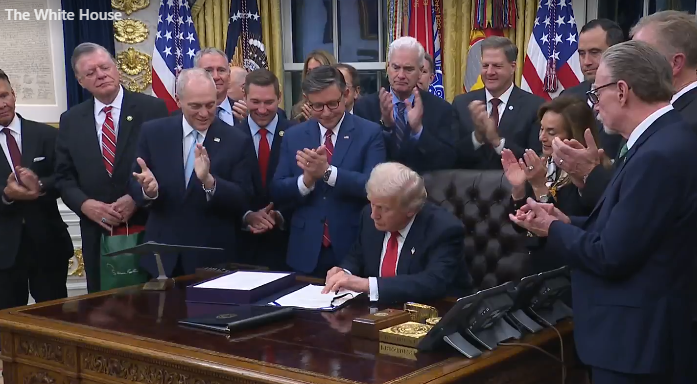
WASHINGTON, D.C. — President Donald J. Trump signed a bipartisan funding bill into law Wednesday night in the Oval Office, officially ending the longest government shutdown in U.S. history after 43 days of partisan deadlock.
The measure, which cleared the House earlier in the evening by a 222-209 vote, restores federal operations effective immediately, with most workers returning to their posts as early as Thursday. Trump, flanked by House Speaker Mike Johnson (R-La.) and other Republican leaders, used the signing ceremony to criticize Democrats for prolonging the standoff.
“We can never let this happen again,” Trump said. “This is no way to run a country.”
The shutdown, which began Oct. 1 over disputes on spending cuts and health care subsidies, surpassed the 2018-19 record of 35 days. It furloughed or left unpaid about 2 million federal employees, disrupted food assistance for 41 million SNAP recipients, and caused flight delays at major airports due to understaffed air traffic controllers.
Key Provisions of the Bill
The legislation combines short-term stability with targeted long-term funding, brokered by moderate senators including Sens. Angus King (I-Maine), Jeanne Shaheen (D-N.H.), and Maggie Hassan (D-N.H.):
- Continuing Resolution (CR): Extends funding for most federal agencies at pre-shutdown levels through January 30, 2026, avoiding another immediate lapse.
- Full-Year Appropriations: Permanently funds three key areas through September 30, 2026:
- Department of Agriculture (USDA) and Food and Drug Administration (FDA): Ensures food safety inspections, rural programs, and full SNAP payments.
- Department of Veterans Affairs (VA): Supports health care and benefits for over 9 million veterans.
- Military Construction and Legislative Branch: Covers base projects, infrastructure, and congressional operations.
- Federal Worker Relief:
- Back Pay: Retroactive compensation for all furloughed or unpaid employees.
- No Layoffs: Bans reductions in force (RIFs) through January 30, 2026, reversing recent terminations and protecting jobs.
- Rehiring: Immediate reinstatement for those wrongfully dismissed during the crisis.
The bill does not include Democrats’ demand for a one-year extension of Affordable Care Act (ACA) subsidies, expiring December 31 and potentially raising premiums for millions. In exchange, Republicans agreed to a Senate floor vote on the issue by mid-December.
Bipartisan Path to Passage
The Senate passed the measure 60-40 on Sunday, with eight Democrats — including Sens. Dick Durbin (D-Ill.), Tim Kaine (D-Va.), John Fetterman (D-Pa.), and Catherine Cortez Masto (D-Nev.) — joining Republicans. Senate Minority Leader Chuck Schumer (D-N.Y.) opposed it, citing the ACA omission.
In the House, six Democrats crossed lines to provide the slim majority: Reps. Henry Cuellar (D-Texas), Don Davis (D-N.C.), Adam Gray (D-Calif.), Jared Golden (D-Maine), Marie Gluesenkamp Perez (D-Wash.), and Tom Suozzi (D-N.Y.). Two Republicans voted no: Reps. Thomas Massie (R-Ky.) and Greg Steube (R-Fla.).
Speaker Johnson hailed the outcome as a victory against omnibus spending, noting it was the fourth time in recent years Republicans blocked such packages.
Shutdown’s Toll and Path Forward
The 43-day impasse cost the economy an estimated $11 billion in permanent GDP losses, per the Congressional Budget Office, with broader ripples including partial November SNAP payments and legal battles over food aid funding. Air travel disruptions, including FAA-mandated cuts at 40 airports, threatened Thanksgiving travel.
The American Federation of Government Employees praised the back-pay and rehiring provisions but warned of lingering morale issues. Democrats, fresh off off-year election wins in Virginia and New Jersey, vowed to push harder on ACA subsidies in December.
With funding secure until January, attention shifts to fiscal 2026 negotiations — and Trump’s call to eliminate the Senate filibuster for smoother governance.
For the full bill text, visit congress.gov. Federal agencies will post resumption updates on their websites.
