

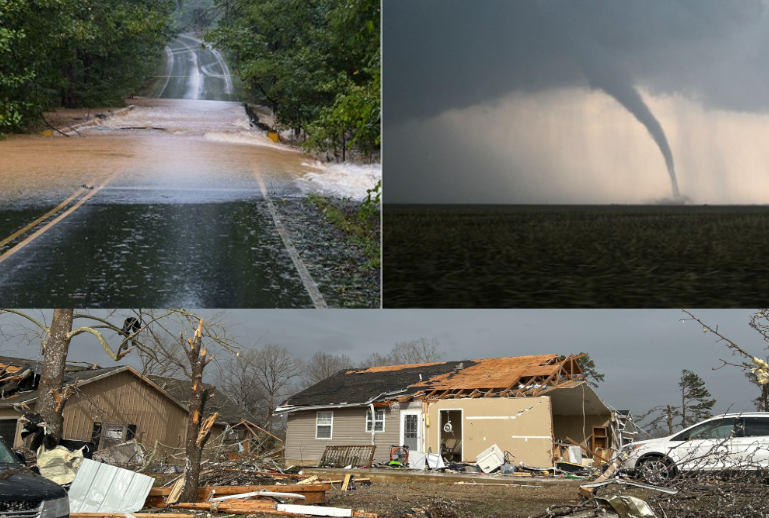
CAVE CITY, Ark. — The communities of Cave City, Jacksonport, Diaz, Campbell Station, and Lake City in Arkansas are battling the aftermath of a devastating tornado outbreak on March 14-15, 2025, with Lake City facing an additional destructive twister on April 2. Compounding their recovery, persistent flooding from early April storms has swollen rivers like the White and Black, testing the resilience of these small towns and highlighting the strain of overlapping disasters in rural Arkansas.
The March 14-15 outbreak unleashed six tornadoes across north central and northeast Arkansas, leaving widespread destruction. In Cave City, an EF-3 tornado with 165 mph winds demolished homes and businesses, particularly in Claxton Loop south of Cushman, where all three fatalities occurred, as confirmed by Independence County Coroner Randell Crabtree. The twister’s 80-mile path made it one of the longest-tracked tornadoes in Arkansas since 2008. An EF-4 tornado with 190 mph winds struck near Newport, impacting Jacksonport, Diaz, and Campbell Station. It grazed the southern side of Jacksonport, intensifying to high-end EF2 strength near The Cut Off oxbow lake with winds of 135 mph, snapping trees and powerlines. Northwest of Diaz along AR 17, it reached peak EF4 intensity, completely sweeping away a well-built home and rolling vehicles hundreds of yards. Campbell Station also reported significant damage, with the storm continuing northeast through Bono and into Paragould, where an EF-2 caused further destruction. In Jacksonport, residents Eddie and Becky Watkins were injured when their home was destroyed, while in Diaz, a police officer was hospitalized after his patrol car was flipped by the winds, landing on another vehicle. Other twisters that night included an EF-4 in Larkin (Izard County) with 170 mph winds, an EF-3 in Fifty-Six (Stone County) with 140 mph winds, an EF-2 in Fitzhugh (Woodruff County) with 120 mph winds, and an EF-2 in Paragould. The outbreak killed three, injured 32, and caused power outages for nearly 17,000 Arkansans.
Lake City faced its own ordeal on April 2, when a “catastrophic” EF-3 tornado with 150 mph winds tore through the town, prompting a rare Tornado Emergency for Craighead and Poinsett counties. The twister destroyed dozens of homes and businesses, flipped cars, and shut down Highways 18 and 135, with debris from Lake City found over 210 miles away in Posey County, Indiana. Four people were injured, but no fatalities were reported. This marked the second major tornado to hit Lake City since 2021, leaving residents like Dallas Hill, who sheltered with his family, to face a scene of utter devastation.
Recovery efforts vary across the region. Cave City, over a month into its recovery, has made progress with debris removal, supported by 52 Arkansas National Guard members and volunteers from Monticello and Little Rock, though some fear the town’s pre-storm vitality may never return. In Jacksonport, Diaz, and Campbell Station, also over a month post-tornado, a relief center at Bratcher Real Estate on Malcolm Avenue in nearby Newport has been distributing grants, but shuttered businesses raise concerns about economic recovery. Lake City, 25 days into its recovery from the April 2 tornado, is focused on clearing debris and reopening highways, a process complicated by the town’s second major tornado in four years.
Governor Sarah Huckabee Sanders declared a state of emergency on March 15, releasing $250,000 in disaster funds for 16 affected counties, including Sharp, Independence, and Jackson. The American Red Cross and KATV Channel 7’s Spirit of Arkansas Disaster Relief Drive have supported Cave City, Jacksonport, Lake City, and Paragould with funds and supplies. Volunteers from Batesville and beyond have been pivotal, with Cave City resident Carrigan noting the selflessness of helpers despite her own losses, including a totaled car.
Adding to the region’s woes, a second wave of severe weather from April 2-7 brought more tornadoes and historic flooding. Lake City endured another EF-3 on April 2, while heavy rainfall—10 to 15 inches in some areas—caused “generational” flooding, a 25-year event per the National Weather Service. In Hardy, near Cave City, the Spring River crested at 23.5 feet, well above its 10-foot flood stage, prompting a curfew until April 8 and emergency rescues. The White River at Newport, which has a flood stage of 26 feet, reached 34 feet, while the Black River at Black Rock, affecting Newport and areas near Cave City, hit 18.1 feet against a 14-foot flood stage. These rivers remained above flood stage as of April 25, with the White River at Newport still at 32.5 feet, posing ongoing risks to recovery efforts in Jacksonport, Diaz, and Campbell Station.
The overlapping disasters highlight systemic challenges. The recovery focus on Cave City and Lake City has been more detailed than in Jacksonport, Diaz, and Campbell Station, suggesting potential disparities in state-level attention, which could hinder long-term rebuilding in these smaller communities near Newport. The flooding has stretched emergency resources thin, with the American Red Cross opening shelters in Hardy for evacuees. Critically, the “generational flooding” label should be tempered—while significant, some areas like Conway reported minimal flooding, indicating uneven impacts. The emotional toll is evident, with Craighead County’s Anthony Coy noting heightened storm anxiety among residents, a sentiment likely shared across these communities.
Despite the hardships, Cave City, Jacksonport, Diaz, Campbell Station, and Lake City exemplify Arkansas’s spirit of mutual aid. As they navigate tornado recovery and persistent flooding, the road ahead remains daunting, but their determination to rebuild underscores the resilience of these small towns.
